
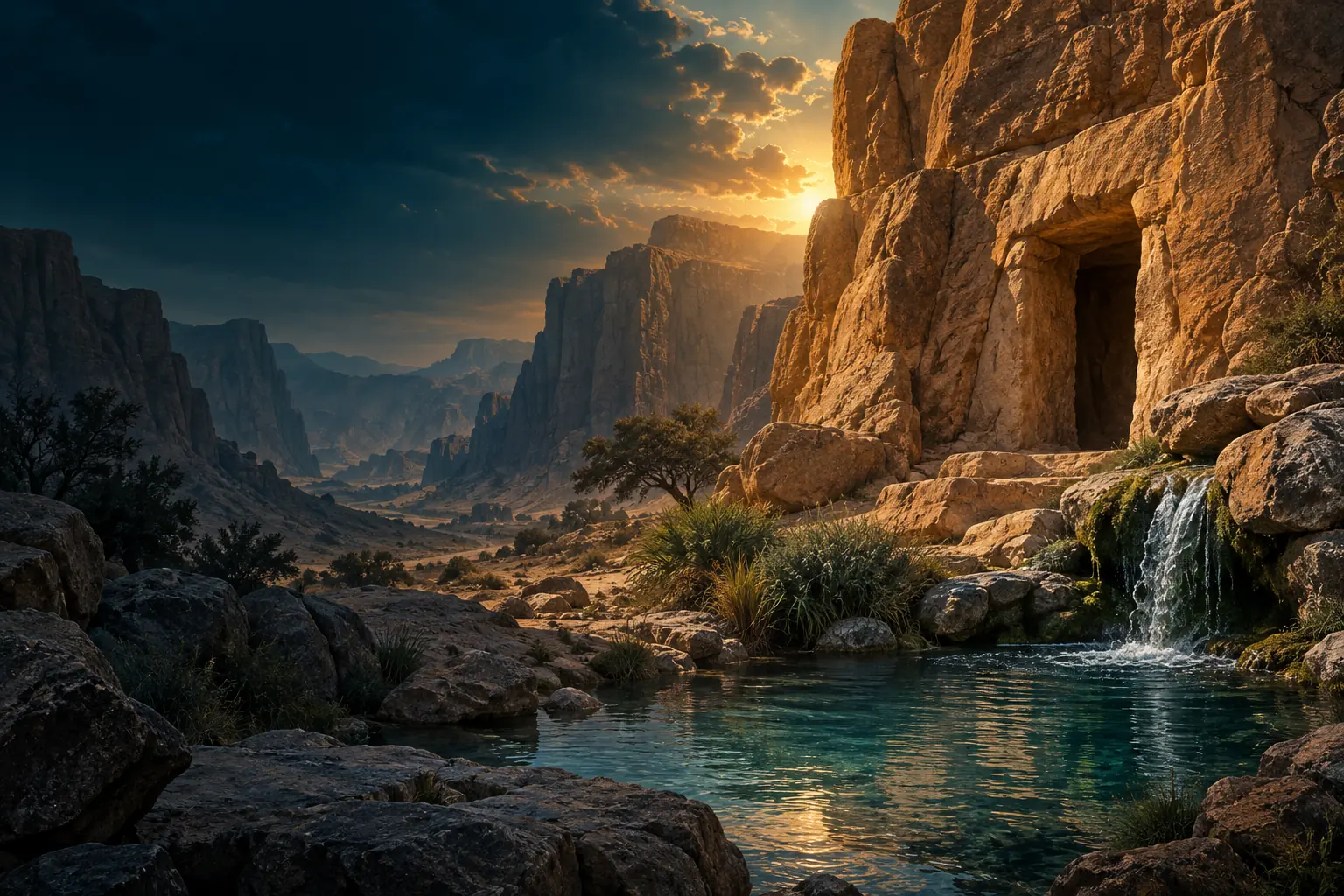
Sandstone dwellings and a spring recall Thamud’s rock-cut setting and the water-sharing test.
The Prophets / Early communitiesA SIGN · A SHARED RESOURCE · A CHOICE

Salih

Salih’s account concerns Thamud, the sign of the she-camel, and the consequences of rejecting guidance.

3 chapters · 3 min read
PROPHETIC LEGACYصالحAN ILLUSTRATED ACCOUNT
UNDERSTAND THE WORLD OF THE ACCOUNT

People, setting, and challenges

01

The people

Thamud, their chiefs, the believers, and the conspirators

02

The challenge

A sign rejected and a community’s deliberate defiance

03

The setting

Mountain dwellings are described; illustrations are not site reconstructions.

A CLOSER READING

Understand Salih’s account

A clear sign becomes a test of shared resources, restraint, and communal responsibility.

Security carved in stone

Salih reminds Thamud of their settlement and their ability to build and carve homes. Their physical security forms the background to a spiritual challenge: benefits should produce gratitude and upright conduct. Impressive houses cannot answer the question of whom a people worship or how they treat a divine warning.
The she-camel and the water

The she-camel is identified as a sign. The people are instructed to let her feed and not harm her; the water has an appointed sharing arrangement. The test is concrete rather than abstract. Restraint has to govern everyday use of a resource, even when some members of the community resent the restriction.

An escalating conspiracy

Al-Naml describes a group of nine who spread corruption and plot against Salih and his household. This supplies a further dimension beyond the killing of the camel: organized wrongdoing and a plan to conceal responsibility. The outcome reverses the conspirators’ expectations and separates their destruction from the rescue of those who believed.

Sandstone dwellings and a spring recall Thamud’s rock-cut setting and the water-sharing test.
THE STORY IN THE LANDSCAPE

A visual thread to remember

Sandstone dwellings and a spring recall Thamud’s rock-cut setting and the water-sharing test. No specific surviving façade is claimed to be theirs.

Conceptual artwork · Explore the source-linked sequence below
READ CONTINUOUSLY

The full collection, together

Read all 3 chapters here, with references beside each part.

Switch to Chapter Reading
QUESTIONS THAT HELP YOU READ

Details worth understanding

Was Salih’s camel an ordinary animal in the story?

The Qur’an presents her as a sign and attaches a specific prohibition against harming her. Details about her emergence that are not in the cited verses should be distinguished from that core account.

Are the maps exact reconstructions?

No. Regional orientation can support reading, but an illustration or plotted area does not verify a specific house, spring, or scene.

THE READING JOURNEY

Chapters in this account

Prefer shorter sessions? Open a chapter for its source passages, reflection, and recall question.

  1. 01

    Thamud and the invitation to worship

    Qur’an 7:73-76
    1 min
  2. 02

    The she-camel and the shared water

    Qur’an 54:23-28
    1 min
  3. 03

    Defiance, conspiracy, and the outcome

    Qur’an 11:64-68
    1 min
See the Story at a Glance
CONTINUE EXPLORING

Connected accounts

THE REFERENCE DESK

Read the sources

Use the chapter references to read each passage in context. Commentary adds explanation; its transmitted reports still require assessment.

Classical reading

Ibn Kathir’s Qisas al-Anbiya provides the classical collection framework. This site uses original prose and keeps Qur’anic and hadith evidence explicit. It does not reproduce a licensed English translation or adopt every transmitted historical detail.

Ibn Kathir · Qisas al-AnbiyaTafsir of the opening passage